AI editorial illustration · imagined reconstruction
CHAPTER 01 / 15A California beginningSingle chapter · AI narrator
Checking narration availability…
AI editorial illustration · not an archival photograph
1964 · OAKLAND
A California beginning
Before the national stage, there was a family in the East Bay.
Kamala Devi Harris was born in Oakland, California, on October 20, 1964. Across the bay from San Francisco, her earliest world was a family taking shape amid the civil rights movement. Her parents had come to the United States from India and Jamaica, and their lives met in California. Kamala and her younger sister, Maya, grew up with those international roots and with the Black community of the East Bay. Long before elections or public office, her story was one of migration, family, and a changing America. California would remain central to her life: the place she returned to for law school and the state where she began her public career.
Kamala Devi Harris was born in Oakland, California, on October 20, 1964. Across the bay from San Francisco, her earliest world was a family taking shape amid the civil rights movement. Her parents had come to the United States from India and Jamaica, and their lives met in California. Kamala and her younger sister, Maya, grew up with those international roots and with the Black community of the East Bay. Long before elections or public office, her story was one of migration, family, and a changing America. California would remain central to her life: the place she returned to for law school and the state where she began her public career.
Her mother, Shyamala Gopalan, was a breast cancer researcher from India. Her father, Donald Harris, was an economist from Jamaica. After their marriage ended, Shyamala became the primary parent raising Kamala and Maya. Harris has described an upbringing that embraced both Indian heritage and Black American identity. Those connections were not separate chapters neatly closed behind her; they became part of the family story she later brought into public life. The two sisters shared a household shaped by their mother's scientific career and the experience of belonging to more than one cultural tradition. Another move would soon take that household beyond California, giving Kamala a very different setting for her teenage years.
Harris spent part of her adolescence in Canada after moving there with her mother. She attended Westmount High School in Quebec and graduated in 1981. The move placed the future American vice president in Montreal during formative school years, between her California childhood and her university education in Washington. Her path was not a straight line through one city or one national setting. By the time she left secondary school, she had lived in both the United States and Canada. The next chapter would bring her to Howard University, a historically Black institution whose students and graduates had long been part of America's debates over education, opportunity, and public service.
At Howard University, Harris studied political science and economics, graduating in 1986. Beyond the classroom, she represented students on the freshman council, joined the debate team, and became a member of Alpha Kappa Alpha Sorority. These were concrete ways of participating in campus life: speaking, organizing, and working alongside other students. Howard connected academic preparation with a community of Black achievement, and Harris continued to identify closely with the university throughout her public career. Her degree opened the way to another kind of training. She returned to California for law school, moving from the study of politics and economics toward a profession in which public questions could become courtroom decisions.
Back in California, Harris enrolled at the University of California, Hastings College of the Law in San Francisco. She earned her law degree in 1989 and was admitted to the California bar in 1990. The sequence matters: graduation was followed by the professional qualification needed to practice law. Her next step was public prosecution in Alameda County, across the bay from her law school and close to the place of her birth. This return brought the geography of her childhood together with the start of her working life. The law would become both her profession and, later, the record on which voters would judge her when she asked to lead an elected office.
Harris began as a deputy district attorney in Alameda County in 1990 and served there through 1998. She then worked in the San Francisco district attorney's office, followed by the city attorney's office, where she led work involving children and families. These posts gave her experience inside local legal institutions before she ran one herself. They also help explain the shape of her later career: her route into electoral politics began through prosecution and city government, rather than through a first campaign for a legislative seat. In 2003, she would ask San Francisco voters to choose her as district attorney. Winning that race would place the choices of an entire office under her leadership.
Harris won the San Francisco district attorney election in 2003 and took office in 2004. In 2005, she created Back on Track, a program intended to reduce repeat offending among certain low-level, nonviolent drug offenders. Her tenure also involved sharply contested decisions. After the killing of police officer Isaac Espinoza in 2004, she declined to seek the death penalty, drawing criticism from police and some fellow Democrats. Together, these episodes show more than a new title: they reveal choices about punishment and the use of prosecutorial authority. The office gave Harris a public record to defend. Her next campaign would take that record before voters across California.
Elected in 2010, Harris became California's attorney general in 2011, the first woman and the first Black person to hold the office. The foreclosure crisis made the treatment of struggling homeowners a central issue. She backed California's Homeowner Bill of Rights, signed by Governor Jerry Brown in July 2012 and effective in January 2013. Among its protections were restrictions on moving ahead with foreclosure while a borrower was being considered for a loan modification, and a reliable point of contact at the lender. This was a move from case-by-case enforcement toward rules for a statewide problem. Harris served as attorney general until 2017, when her career shifted from California law enforcement to federal legislation.
Harris won election to the United States Senate in 2016 and took her seat in January 2017. She became the second Black woman and the first person of South Asian descent to serve in the Senate. Her committee assignments included intelligence and the judiciary, bringing her questioning style into nationally watched hearings. She also pursued legislation: in 2017, she joined Republican Senator Rand Paul on a proposal to encourage changes to money bail. A proposal was not an enacted reform, but it illustrates work beyond the hearing room. The Senate gave Harris a national platform, and in 2019 she used it as the starting point for her first presidential campaign.
Harris announced her first presidential campaign in January 2019, seeking the Democratic nomination for the 2020 election. She withdrew in December 2019, before the primary voting began. That setback did not end her role in the election. In August 2020, Joe Biden selected her as his running mate, and the Biden-Harris ticket won the general election. Within a year, she had moved from ending her own campaign to preparing for the vice presidency. The reversal is an important part of the story: her first attempt to reach the White House did not succeed on its original terms. A different role emerged through the Democratic ticket and the voters' decision in November.
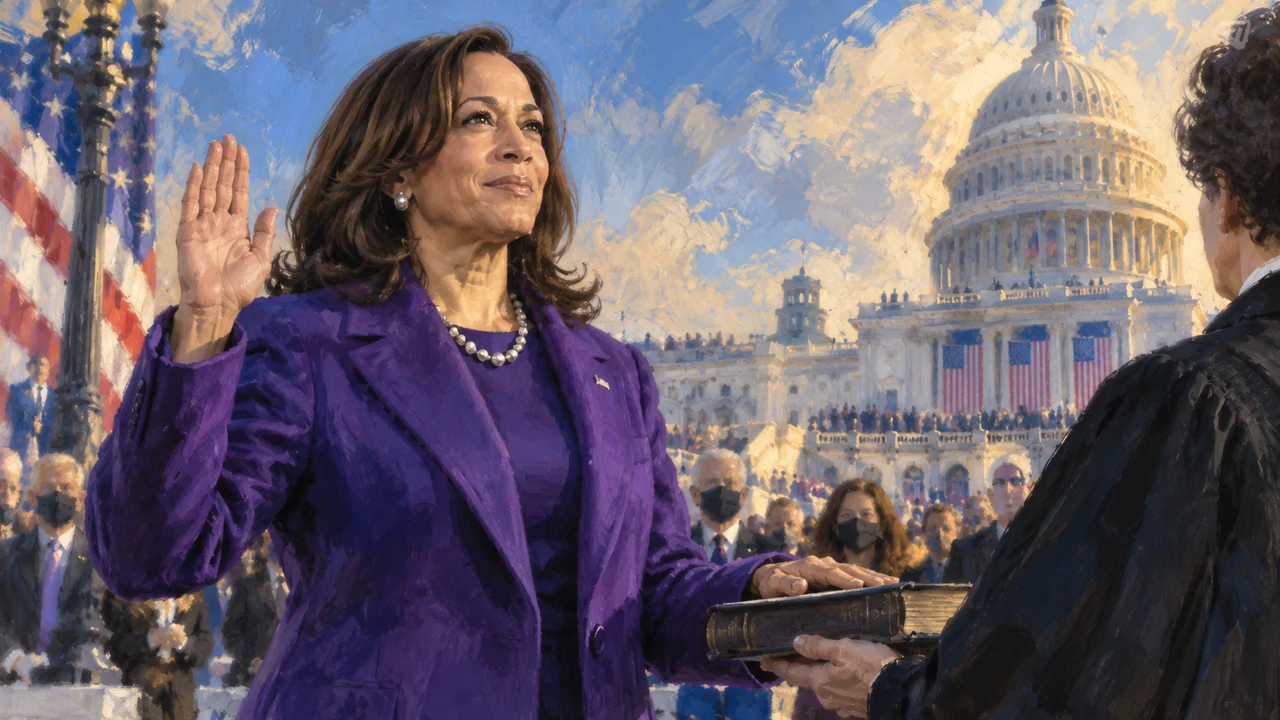
On January 20, 2021, Harris became the forty-ninth vice president of the United States. She was the first woman, the first Black American, and the first person of South Asian descent to hold the office. The inauguration brought a career that began in local prosecution to one of the nation's highest constitutional positions. For a country in which no woman had previously served as vice president, the change was a historical first as well as a personal milestone. The ceremony was the beginning of a term, not its accomplishment in full. What followed would be measured through governing responsibilities, Senate votes, and the choices of the administration she served with President Joe Biden.
The vice presidency placed Harris at the intersection of the White House and a closely divided Senate. Over her term she cast thirty-three tie-breaking votes, according to the Senate's official record. Outside the chamber, she became a prominent advocate for abortion rights. In January 2024, she began a nationwide reproductive freedoms tour in Wisconsin, making the consequences of abortion restrictions a central part of her public argument. These were different forms of the same office: a constitutional role in legislative decisions and a political role communicating the administration's priorities. Her advocacy met opposition from Republicans, and it did not itself restore nationwide abortion protections. Later that year, her responsibilities would expand again when the presidential campaign changed course.
President Biden ended his reelection campaign in July 2024, and Harris became the Democratic presidential nominee. With Minnesota Governor Tim Walz as her running mate, she entered an unusually compressed race. Her later memoir would call it 107 Days, counting the campaign from Biden's withdrawal to Election Day. The result was defeat: Donald Trump won three hundred twelve Electoral College votes, while Harris received two hundred twenty-six. The historical significance of her candidacy did not change that outcome. It belongs plainly in her biography, alongside the offices she won. The campaign would also become the subject of her next major public project: an account of what happened during those months and how she understood the experience afterward.
Harris left the vice presidency on January 20, 2025. In July, she announced that she would not run for governor of California in 2026, closing one possible route back into elected office. Another public chapter centered on writing. Her memoir, 107 Days, was published on September 23, 2025, recounting the brief 2024 presidential campaign. It offered her own perspective on the race rather than an independent verdict on its outcome. The book and her continued public appearances kept that experience in the conversation after her term ended. By April 2026, she was also addressing a new question directly: whether she might seek the presidency again in 2028.
On April 10, 2026, at the National Action Network convention in New York, Harris said she was considering another presidential run in 2028. That dated statement expresses interest; it is not the same as launching a campaign. Any future bid would still involve her own decision, a contest for the Democratic nomination, and ultimately the choices of voters. Her record gives those discussions a starting point, from California prosecution to the Senate, the vice presidency, and the 2024 defeat. The next chapter remains open. For this independent community, looking toward 2028 means following actual announcements and proposals as they appear, without presenting a hoped-for candidacy, platform, or victory as an established fact.