
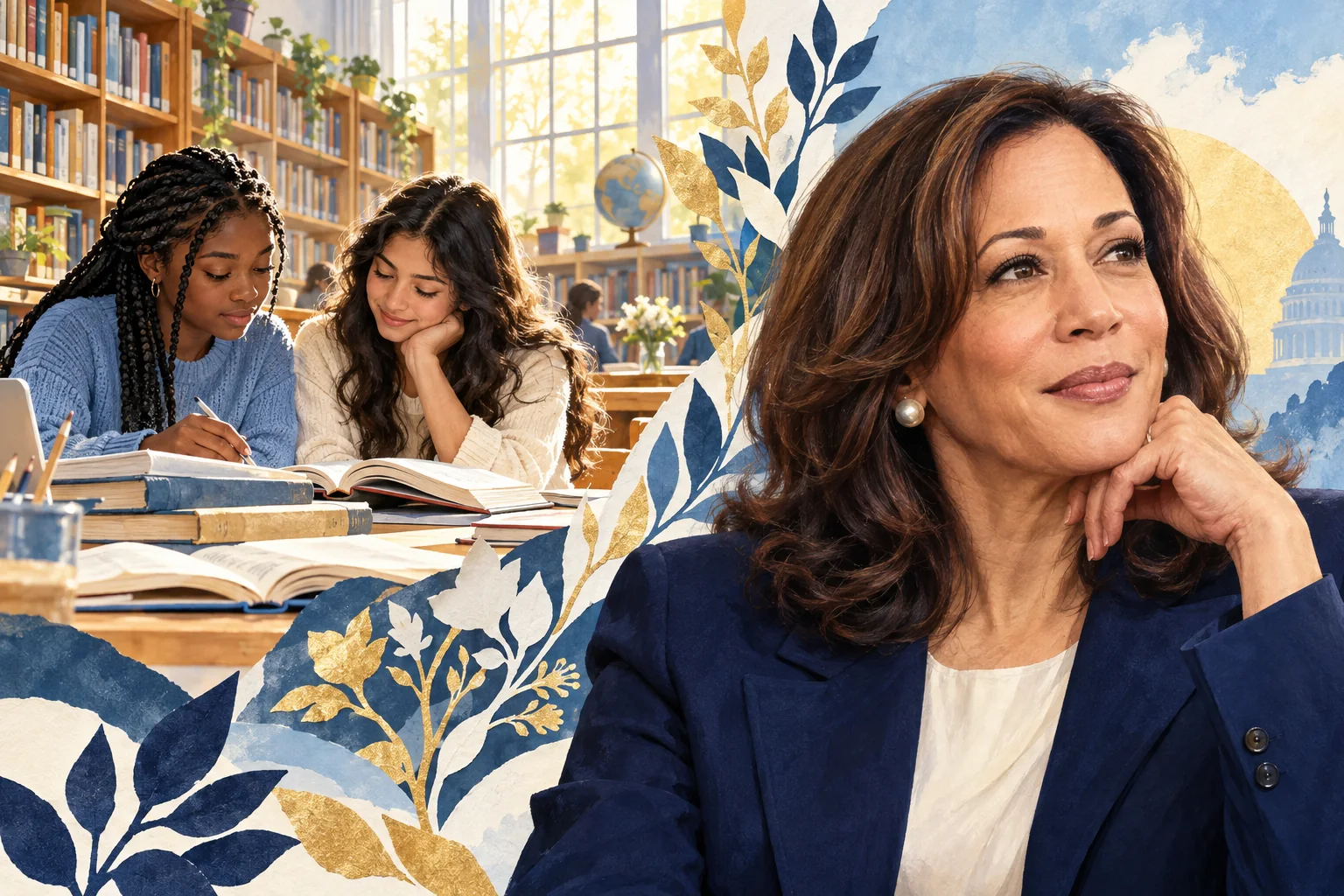
On International Day of the Girl, new UNESCO findings are putting a practical question beside the celebration of women's leadership: what allows a girl to stay in school and shape her own future? The October 11 observance arrives just after a global education report and awards recognizing projects in Morocco and Peru. Together, they offer a more concrete starting point than a collection of inspirational portraits.
For a publication following Kamala Harris, the connection is historical representation. Her election to the vice presidency remains a milestone. The developments reported here, however, come from international education organizations; they are not a new Harris announcement or evidence of her involvement in the awarded projects.
This year's focus: rights and the conditions for learning
UNICEF's 2026 observance page identifies this year's theme as “End child marriage and invest in girls' rights.” The agency says the theme emerged from consultation with girls, organizations and other partners. It connects prevention with education, health, protection and girls' ability to participate in decisions affecting them.
The theme is specific enough to ask measurable questions. Which barriers prevent attendance? What happens after a student leaves school? Who can access support, and who remains outside it? A public commitment becomes easier to evaluate when those questions accompany the announcement. The number of speeches delivered on an observance day cannot answer them.
UNESCO's account of the observance places October 11 within the international recognition of girls' rights. That recognition matters, but a calendar date is a prompt for sustained reporting. Conditions in a classroom, a household and a local institution need examination beyond the anniversary itself.
A new report distinguishes enrollment from completion
In a report announcement published October 8 and updated October 9, UNESCO describes narrowing global gender gaps in school enrollment while identifying early marriage as a continuing obstacle. Its 2026 Global Education Monitoring Gender Report highlights differences obscured by aggregate figures, including the circumstances of girls in poorer and rural households.
The release also examines the distance between a legal right to education and the ability to exercise it, particularly for pregnant and parenting students. Practical barriers include transport, childcare, safety and stigma. A rule permitting return to school does not itself supply the conditions that make returning possible.
Those distinctions change how an education story should be read. Enrollment measures entry into a system. Attendance describes continued participation. Completion records a later outcome. Learning asks another question altogether. A favorable movement in one measure cannot silently stand in for all the others, and a global average cannot describe every community within it.
Consider a hypothetical district that removes a formal restriction but offers no affordable route to school. The policy change is real; the access problem may remain. Reporting both facts is more informative than calling the reform either a complete success or entirely meaningless. The next useful evidence would show how many affected students returned, what support they received and whether participation continued.
Morocco and Peru provide concrete projects to examine
On October 9, UNESCO announced its 2026 Prize for Girls' and Women's Education. The recognized initiatives were Project Soar in a Bag in Morocco and CARE Peru's Girls with Opportunities. Each received US$50,000 at a ceremony in Paris.
UNESCO describes the Moroccan project as combining locally trained women facilitators with girls' rights, confidence and life planning. The Peru initiative supports rural and Indigenous girls through education, mentoring and opportunities in science and technology. These are distinct settings and approaches, brought together by the prize's focus on education.
An award identifies work that deserves attention; it does not remove the need to examine evidence. Participation totals, completion rates and personal accounts illuminate different aspects of a program. Readers should ask which students were included, what period was measured and whether an outcome describes participants alone or a wider population. A reported improvement also needs context before it becomes a claim that one intervention caused the entire change.

Harris's milestone belongs in its historical frame
The U.S. House of Representatives' historical biography records Harris as the first woman, first African American and first Asian American elected vice president. She served from January 20, 2021, to January 20, 2025. That record establishes the milestone without requiring a claim about what every girl thought or how a particular education outcome changed because of it.
Representation and access are connected subjects, but they require different evidence. A prominent first can broaden a public conversation about leadership. Whether a student has time, safety, resources and institutional support to pursue her ambitions is a question about her circumstances. Responsible coverage can acknowledge the symbolic significance while keeping those practical conditions in view.
Our Her Story timeline provides the historical context for Harris's career. Today's new reporting concerns UNESCO's report and awards, alongside the October 11 observance. Keeping those dates and sources visible prevents a commemorative feature from implying an unverified appearance, endorsement or policy announcement.
The strongest follow-up to this year's theme will document what happens after the attention moves elsewhere: whether support reaches the students described, whether returning students remain, and whether girls' own accounts influence how programs are assessed. Under KHive Next's editorial policy, those outcomes deserve the same scrutiny as the promises and celebrations that precede them.