New Michigan reporting puts Harris’s coalition role under a harder test
Fresh reporting from Michigan shows why Kamala Harris’s support for Abdul El-Sayed now depends less on celebrity and more on whether the campaign can build trust with Black voters while confronting anti-Muslim attacks.
By KHive Next Editorial Desk
AI-assisted editorial illustration of three generations entering a welcoming Michigan community forum after autumn rain
DISCUSSION OPENRead the source brief, then add your evidence and argument.
Fresh reporting from Michigan has sharpened the stakes of Kamala Harris’s decision to campaign for Democratic Senate nominee Abdul El-Sayed. The issue is no longer simply whether a former vice president can draw attention to a battleground race. It is whether Harris can help turn attention into trust across parts of the Democratic coalition that remain unconvinced, while refusing to let anti-Muslim attacks define either the candidate or the campaign.
Two reports published Sunday, October 11, make that challenge more concrete. The Associated Press described El-Sayed as the central figure in one of the country’s most consequential Senate contests, facing a Republican effort backed by tens of millions of dollars to portray him as dangerous or radical. The Guardian reported a different vulnerability: Democratic preference for Senate control appears stronger among Black voters than support for El-Sayed himself. Together, those stories create a test for Harris that is more specific than the usual debate about her 2028 prospects.
What changed in the Sunday reporting
The AP’s new profile depicts a race in which El-Sayed has embraced the spotlight rather than retreating from it. The article describes his statewide travel, his focus on health care, paid leave and household costs, and the scale of spending around the contest. It also reports that Republican attacks have repeatedly emphasized his Muslim faith and progressive identity. That campaign environment matters to Harris because her September appearance with El-Sayed was meant to demonstrate that national Democratic leaders would not abandon a nominee after a difficult primary.
The Guardian’s reporting adds a coalition problem that cannot be answered by media attention alone. Citing a Washington Post–Schar School poll, it reported that 83 percent of likely Black voters wanted Democrats to control the Senate while 67 percent supported El-Sayed. Those figures are not a prediction of the final result, and a single poll cannot measure every reason for hesitation. But the gap is large enough to make persuasion and familiarity central campaign questions rather than side issues.
The Guardian also described a Flint rally where Black attendance appeared low, while noting that a separate private gathering with local Black leaders drew a much stronger Black presence. That contrast argues against a simplistic conclusion that Black voters are uniformly disengaged. It suggests that venue, messenger, relationship and format may matter as much as a national endorsement.
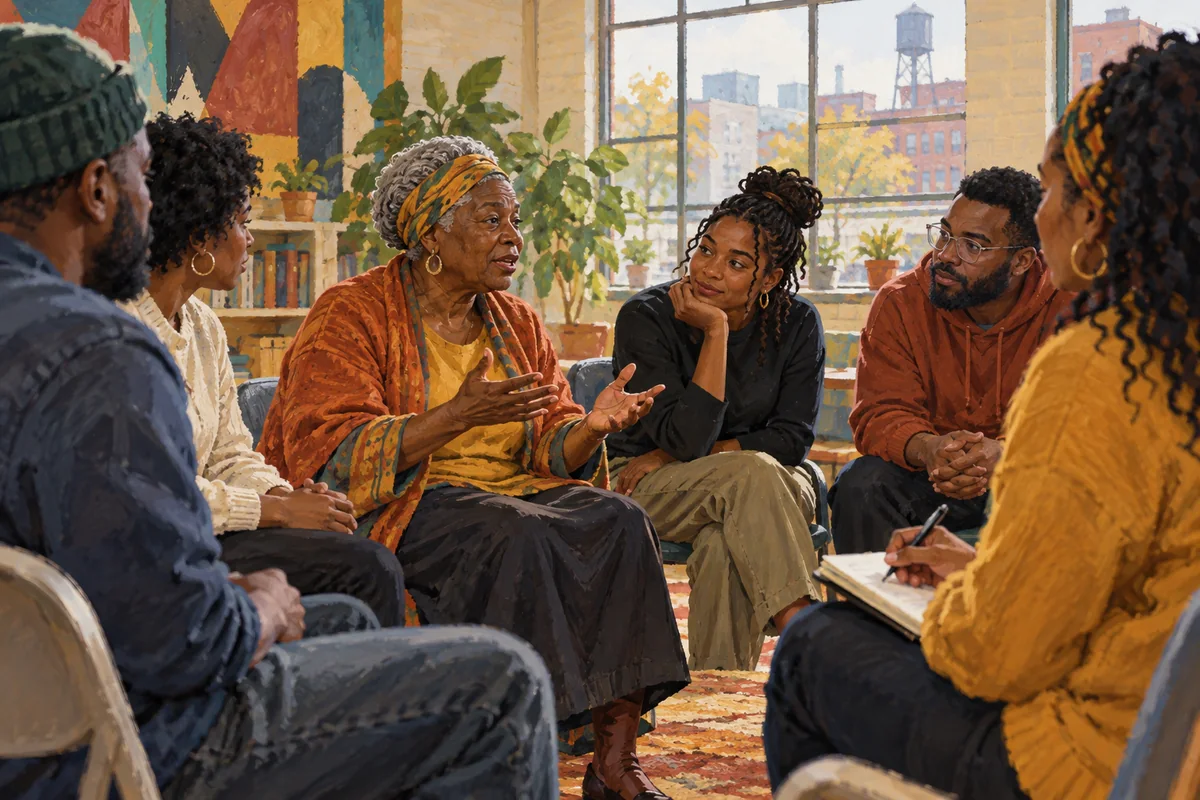
This invented listening circle illustrates the local trust-building work described in the reporting; it does not depict a documented Harris or El-Sayed event.AI-generated illustration · Not an event photograph
Harris’s most useful role, then, may be to help create more spaces where voters can ask questions and hear direct answers. That is different from treating her popularity as a transferable block of votes. Our earlier report on her Detroit maternal-health roundtable showed why a policy-centered setting can be more substantive than a generic rally: it put Black maternal health, Medicaid and research funding at the center of the conversation.
Harris’s endorsement carries both reach and history
When Harris campaigned with El-Sayed in Detroit on September 22, she called the midterms a possible “stopgap” on the Trump administration and urged Democratic unity. AP’s account of that visit emphasized the importance of Michigan to Senate control and the unresolved tensions created by the primary. Harris also used a Black maternal-health roundtable to connect the race to a policy issue she has addressed for years.
That visit gave El-Sayed access to a nationally known figure with deep support among many Black Democrats. It did not erase real disagreements. The Guardian noted that El-Sayed had criticized Harris over Gaza policy even though he later endorsed her in 2024. It also reported that some voters remain unfamiliar with him or uncertain about how his universal economic message speaks to the specific experience of Black communities. A credible coalition cannot ask voters to forget either policy differences or the ways those differences were expressed.
This is where Harris’s involvement can be valuable if it is precise. She can validate the importance of the Senate race without demanding personal loyalty to herself. She can connect maternal health, voting rights, small-business access and household costs to local experience. And she can model disagreement inside a coalition without accepting attacks based on faith. That is a narrower job than leading the entire campaign, but it is also more measurable.
The distinction matters because the latest KHive analysis argued that selective surrogate work should strengthen local campaigns rather than replace them. Sunday’s Michigan reporting supplies a real-world case. The relevant question is not how many headlines Harris generates. It is whether the campaign follows her appearance with sustained local outreach, especially through trusted Black institutions and organizers.
Anti-Muslim attacks cannot become the organizing principle
The coalition challenge exists alongside a campaign climate that requires a clear moral line. Reuters reported in September that Republican politicians were making Muslims and Islam a campaign issue in several states, with El-Sayed at the center of national attacks. Reuters noted that critics described the rhetoric as fear-mongering, while Republicans said they were raising questions about security and extremism.
Voters are entitled to examine El-Sayed’s record, policies, associations and statements. They are also entitled to reject him. But criticism of a candidate is not the same as treating a candidate’s faith as evidence of disloyalty. Harris’s presence can help Democrats draw that distinction without avoiding difficult questions. She can insist that policy scrutiny be specific and factual while rejecting collective suspicion of Muslim Americans.
That approach also protects the campaign from an unhelpful shortcut. If every hesitation is labeled prejudice, organizers may miss legitimate concerns about health policy, foreign policy, campaign style or local representation. If anti-Muslim attacks are treated as ordinary political criticism, the campaign normalizes a religious test. The responsible path is to separate the two carefully and answer each with evidence.
The calendar turns the argument into field work
Michigan’s official election calendar makes the next phase clear. The Michigan Department of State lists November 3 as Election Day, October 19 as the final day for online or mail registration, and October 24 through November 1 as the constitutionally mandated early-voting period. Harris’s September visit occurred before those deadlines. The value of that appearance will be judged by what organizers do with the remaining time.
This invented civic scene explains Michigan’s accessible early-voting period and does not represent a real polling place or documented event.AI-generated illustration · Not an event photograph
For Harris, the practical contribution could include directing volunteers toward accurate voting information, elevating accessible voting options, and returning attention to policy commitments that matter locally. Michigan says voters can use early-voting sites during the mandatory period and provides resources for accessible voting. A responsible fan community should link voters to official information rather than repeat unofficial location or deadline claims.
The October 24 start of mandatory early voting also coincides with Barack Obama’s scheduled appearance for El-Sayed, according to the Guardian and earlier AP reporting. That sequence gives Democrats two prominent national surrogates, but it does not guarantee support will transfer. Campaigns will still need trusted local messengers, repeated contact and answers to questions that national figures cannot provide in a single visit.
What to watch next
Three things would show whether Harris’s intervention is helping. First, does the campaign hold more small, policy-specific events with Black community organizations rather than relying mainly on large rallies? Second, does El-Sayed directly address the difference between a universal economic message and the specific experiences voters say they want acknowledged? Third, can Democrats reject anti-Muslim rhetoric while maintaining honest scrutiny of the candidate’s positions and past statements?
There is uncertainty on every point. Polling can move, turnout models can miss, and a Senate race is shaped by far more than one surrogate. Sunday’s reports do not prove that Harris can close the coalition gap, or that the gap will determine the result. They do show why her Michigan role should be judged as organizing work, not celebrity theater.
KHive Next is an independent, unofficial fan community. It is not affiliated with Kamala Harris, any campaign, the Democratic Party or the El-Sayed campaign. This article distinguishes reported events from interpretation and uses conceptual AI-assisted editorial illustrations rather than documentary images.