Household costs lead the midterm agenda. What should Harris coverage ask?
New issue surveys put everyday economics at the center of the campaign. Assessing an affordability promise requires prices, household effects, funding and institutional limits.
By KHive Next Editorial Desk
AI-assisted editorial illustration of Kamala Harris beside an imagined kitchen and grocery bag; a conceptual image, not a photograph of a campaign event.
DISCUSSION OPENRead the source brief, then add your evidence and argument.
The newest midterm issue surveys put household economics at the center of the campaign conversation Kamala Harris has rejoined. That is a concrete development for readers following her public role: the debate is taking place in an electorate that gives high priority to the economy and everyday costs. The surveys do not, however, constitute an endorsement of any politician's proposed remedy.
This October 9 analysis examines the published research and the standards needed to assess an affordability promise. It does not announce a new Harris economic platform. It also distinguishes public perceptions of prices from official price measurement, and campaign criticism from evidence that a particular policy would improve a household budget.
The latest surveys ask different questions
Pew Research Center's October 8 issue report finds that 84% of registered voters describe the economy as very important to their congressional vote. The figure is 88% among Democratic candidate supporters and 82% among Republican candidate supporters. The economy leads the issue list on both sides, even as other priorities differ.
The Reuters/Ipsos October 8 topline uses a different format: respondents choose a single most important factor from a list. Cost of living is selected by 52% of adults and 50% of registered voters. The difference between those findings and Pew's 84% is not a contradiction; one question asks for a top choice, while the other allows respondents to rate several issues highly.
The studies therefore support a narrower, more useful conclusion than a sweeping claim that voters agree on an economic program. They identify the salience of a concern. They do not establish agreement about taxes, trade, spending, regulation or the best combination of those policies.
Harris's current role supplies context, not a new plan
The DNC's October 6 account of an October 5 organizing call records Harris urging voter engagement alongside party chair Ken Martin and labor leader Liz Shuler. It presents a party mobilization effort, including congressional, state and local contests. Because this is a party source, its description of campaign prospects should be understood as the organizers' account.
KHive Next has already reported that organizing development in its morning article. This additional piece addresses a different question: how should readers assess economic claims made in that campaign environment? An appeal to participate does not provide the details of an affordability proposal, and a new poll does not supply those missing details.
The connection is analytical rather than an assertion about Harris's private strategy. When economic concerns are prominent in the public record, coverage of a political figure's policy claims should explain the household effect being promised. It should also identify where the figure is supporting another candidate rather than announcing a policy of her own.
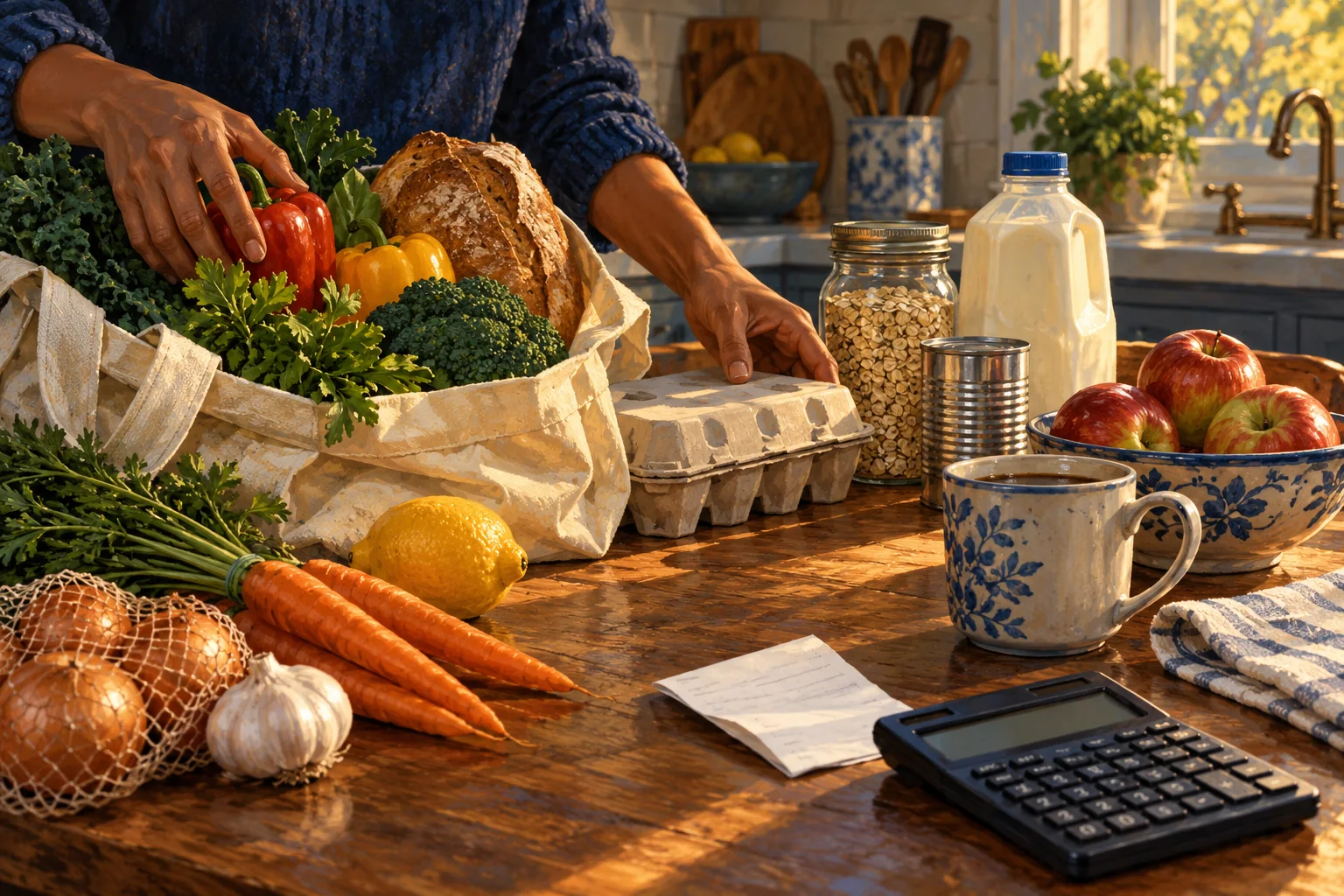
Conceptual AI-assisted artwork of household budgeting. The imagined receipt and groceries are not price data, and no figures in the article are inferred from this scene.AI-generated illustration · Not an event photograph
Prices, inflation and the family budget
The Bureau of Labor Statistics' CPI explanation describes the Consumer Price Index as a measure of average price changes for consumer goods and services. A measure of change is not the same as the level of a particular household's bills. A family also buys a different mix of items from the average represented by an index.
Consider a simplified example, not a report of current U.S. inflation: if a basket rises from $100 to $110 and then to $112, the second increase is slower, but the basket still costs more than at the start. Saying price growth has slowed would be mathematically consistent with saying that basket remains expensive. Neither statement alone describes what happened to the family's income.
That distinction is important when a political argument moves between national statistics and personal experience. A statistical improvement need not mean that every bill fell. A difficult household experience, meanwhile, does not invalidate an average. The reporting task is to specify which claim is being made and choose evidence that actually addresses it.
Ask what changes, for whom, and when
An affordability proposal becomes easier to evaluate when its mechanism is explicit. Is it intended to reduce a purchase price, lower a tax bill, increase income or change the availability of a service? Each route could affect a household differently. Describing them all as lowering costs can hide choices that deserve public scrutiny.
A hypothetical payment illustrates the issue. It might improve what a recipient can afford without reducing the posted price of groceries. A hypothetical increase in housing supply might aim at a different problem and operate over a different period. These examples are ways to read a promise, not claims that Harris has announced either measure today.
The financing question belongs in the same account. If a proposal costs public money, the explanation should identify the proposed funding or trade-off. If it relies on private behavior changing, the explanation should state that assumption. If the benefit takes time, the timetable should be part of the headline claim's context.
An imagined committee room represents scrutiny of economic proposals. This AI-assisted illustration does not depict an announced hearing, a real bill, or a government finding.AI-generated illustration · Not an event photograph
Match the promise to the institution
The Senate's account of its powers and procedures distinguishes legislation, investigations and other responsibilities. That is a reminder to identify which institution would need to act. A campaign statement does not itself enact a benefit, appropriate funding or establish the effectiveness of a proposal.
For coverage of Harris and the candidates she supports, the useful sequence is claim, mechanism, responsible institution and evidence. A criticism may identify a genuine concern while leaving the remedy unresolved. A proposed remedy may deserve examination without being treated as guaranteed relief. Keeping those stages separate makes accountability possible after an election as well as before it.
The new issue findings make everyday economics a necessary subject of scrutiny. They do not remove the need to examine competing explanations or the distribution of costs and benefits. Under KHive Next's editorial policy, this analysis presents the research as evidence of public priorities and the policy checklist as our interpretation—not as a forecast, a newly announced Harris platform, or a recommendation on how anyone should vote.