Kamala Harris plans Michigan return for a maternal-health discussion
Harris is expected in Michigan on September 22. A preview of the reported plans, the maternal-health policy context, and what still needs confirmation.
By KHive Next Editorial Desk
AI-generated editorial illustration: adult hands cradle a baby's hands amid aqua waves and stylized Great Lakes shapes, symbolizing maternal care rather than an actual visit.
DISCUSSION OPENRead the source brief, then add your evidence and argument.
Kamala Harris is expected to return to Michigan for an appearance with Democratic Senate nominee Abdul El-Sayed on Tuesday, September 22, 2026. The Associated Press reported on September 16 that a campaign spokesperson described a planned roundtable on Black maternal health. AP also reported plans for meetings with local officials and the NAACP. This is a preview of an announced itinerary, not an account of an event that has already happened.
What is confirmed, and what remains a plan
The reporting supplies a subject and an intended date. It does not give us an observed discussion, a transcript of remarks, an independently verified attendance list or outcomes from the meeting. This article does not identify a specific venue because we have not confirmed one. A news report's dateline should not be confused with an event location.
That distinction is especially important when a recognizable political figure returns to a closely watched state. Pictures from earlier appearances can circulate beside new headlines, and a future-tense schedule can be mistaken for a completed visit. Our illustrations are newly created concepts; none is presented as a photograph of Harris attending the September 22 discussion.
The substantive question for this preview is what a maternal-health conversation could usefully address. The sections below supply public policy context and identify questions for follow-up. They do not attribute unspoken proposals to Harris or El-Sayed, and they do not claim that invited participants have endorsed a particular measure.
The national data behind the subject
The CDC's March 2026 report on maternal mortality in 2024 records 649 maternal deaths nationally. Its rate for non-Hispanic Black women was 44.8 deaths per 100,000 live births, compared with 14.2 for non-Hispanic White women. Those are national figures for 2024, not a measurement of conditions in Michigan in September 2026.
The report defines maternal deaths within pregnancy or 42 days after its end, excluding accidental or incidental causes. It also says the overall decline from 2023 was not statistically significant. Those qualifications matter: a lower count should not automatically be described as proof of a sustained improvement, and a measure with one time window should not be silently substituted for a different measure covering a longer postpartum period.
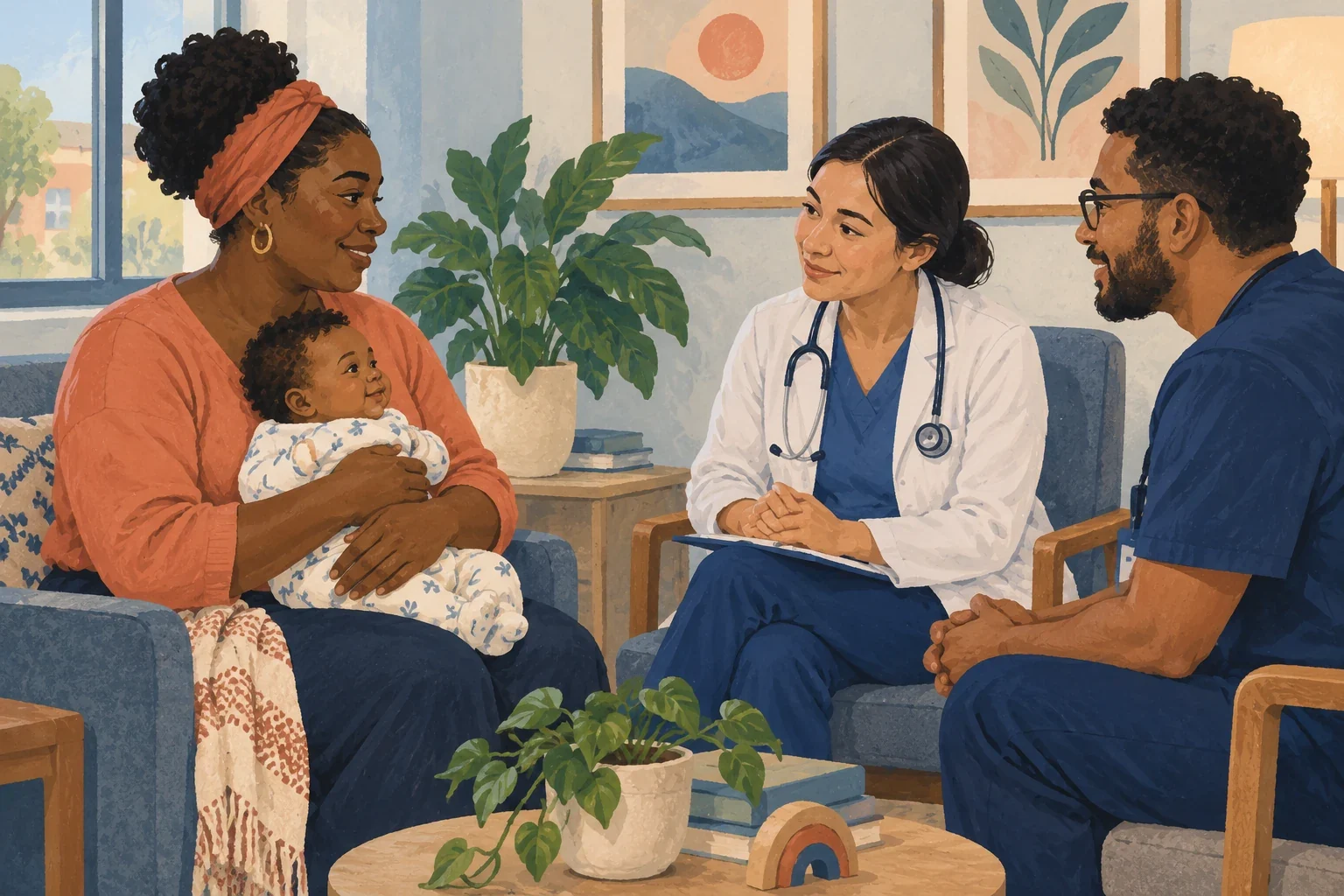
The planned discussion concerns Black maternal health. These fictional people illustrate a conversation about care; they are not named participants, patients or attendees at the scheduled roundtable.AI-generated illustration · Not an event photograph
KHive Next analysis: a discussion of the disparity becomes more useful when it asks what evidence would demonstrate improvement. Which outcome is being measured? Over what period? At what geographic level? A national comparison can establish the importance of a subject while still leaving questions about local conditions, implementation and the performance of particular programs.
Michigan already has a policy record to examine
The Michigan Department of Health and Human Services' Doula Initiative is one concrete point of reference. The department describes doulas as providing nonclinical emotional, physical and informational support before, during and after birth. Its program page links to Medicaid coverage materials and says an October 2024 bulletin increased covered visits and reimbursement rates.
The state page also describes work to expand the doula network, support providers and families, and maintain a registry. These are existing program descriptions, not proposals announced at the upcoming event. Readers seeking service details should consult the linked state materials rather than treating a campaign article as individual eligibility or medical guidance.
For the eventual discussion, useful accountability questions would include whether eligible families can find a participating provider, how the program reaches people outside major population centers, and how access is evaluated. These are questions from this editorial desk. We have not established that the speakers plan to address them, or that any particular answer would demonstrate the success of the whole initiative.
Harris's earlier record supplies context
The archived Biden White House biography of Harris identifies maternal health as part of her work in the Senate and describes the administration's expansion of postpartum Medicaid care. As an administration biography, it is a first-party description of a record. It provides historical context, but is not an independent evaluation of program outcomes or a current statement of her 2026 proposals.
A follow-up story should distinguish at least three things: a previous administration's policy, a current proposal by an individual politician, and the experiences described by people participating in a discussion. They may be connected, but they are different forms of evidence. A patient's experience deserves accurate attribution; it cannot alone establish a statewide trend, just as a statewide average cannot fully describe one family's experience.
A fictional community discussion evokes the local voices relevant to maternal-health policy. The Detroit skyline is symbolic and does not establish the venue of Harris's planned Michigan appearance.AI-generated illustration · Not an event photograph
A Michigan appearance is not a presidential announcement
The visit is also likely to be discussed alongside speculation about Harris's future. Our report on Newsom's conditional 2028 statement explains why a possible future candidacy must be distinguished from a declared one. A public appearance can have political significance without answering whether someone will seek another office.
That is why this preview does not turn the scheduled trip into a forecast about the next presidential election. Nor does it infer that a group mentioned in an itinerary supports a future candidacy. Meetings, organizational endorsements and the decisions of individual voters are separate matters, and each requires its own evidence.
For the broader election context, see our 2026 House and Senate explainer. It separates congressional races from presidential speculation. That distinction allows the policy subject of the Michigan event to receive attention in its own right, rather than being reduced to a signal in a hypothetical contest.
What a complete follow-up should establish
After September 22, the first question is whether the planned appearance took place and whether its format changed. A useful report would identify the actual speakers, link to available remarks, describe any specific policy commitments and distinguish questions answered from those left open. If a proposal is announced, its funding, implementing authority and timetable deserve scrutiny.
This page will need a dated update if the schedule changes; it should not be silently converted into an eyewitness account. Until attendance and remarks are verified, the appropriate description remains a planned return. Our editorial policy requires sourced facts, clear separation of analysis, and three labeled illustrations with explanations and alternative text.