Kamala Harris returns to Michigan as voter groups warn of a funding squeeze
Kamala Harris's planned Michigan visit now sits beside a new national warning: voter-engagement groups say money and staffing are falling short just as 2026 voting begins. The overlap raises a practical question about whether high-profile appearances can reinforce, rather than replace, year-round local organizing.
By KHive Next Editorial Desk
AI-assisted editorial illustration of an autumn Michigan organizing room with empty chairs, blank clipboards and outreach materials awaiting volunteers
DISCUSSION OPENRead the source brief, then add your evidence and argument.
Former Vice President Kamala Harris is scheduled to return to Michigan on Tuesday, September 22, for her first public appearance with Democratic U.S. Senate nominee Abdul El-Sayed since endorsing him after the primary. The visit was already significant because Michigan is a must-hold Senate state for Democrats. A new report published Sunday adds another layer: organizations that register, inform and mobilize voters say they are entering the final stretch of the 2026 midterms with serious funding and staffing gaps.
The two developments are related by timing, but they are not the same story. Harris's announced program includes a roundtable on Black maternal health, meetings with local elected officials and a meeting with the Rev. Wendell Anthony, president of the Detroit Branch NAACP. The national funding warning concerns the broader infrastructure that turns public attention into registration, voter education, transportation and turnout. There is no public evidence that Harris's trip was designed as a response to the new funding report, and this article does not claim that it was.
What is clear is that Harris will arrive in Michigan while organizers are describing a narrowing window to reach voters. That makes the visit a useful test of what a prominent national Democrat can contribute beyond a single stage or headline.
What Harris is scheduled to do in Michigan
The Associated Press reported on September 17 that Harris and El-Sayed plan to appear together at a Tuesday roundtable focused on Black maternal health. El-Sayed is a physician and previously led health departments in Detroit and Wayne County. He is running against Republican Mike Rogers for the seat held by retiring Democratic Sen. Gary Peters.
According to the same report, Harris also plans to meet local elected officials and Anthony during the visit. Her spokesperson said the former vice president is returning to help turn out voters in a state that will be central to Senate control. The event is therefore both a policy appearance and an electoral intervention, even though the publicly announced roundtable has a specific health-care focus.
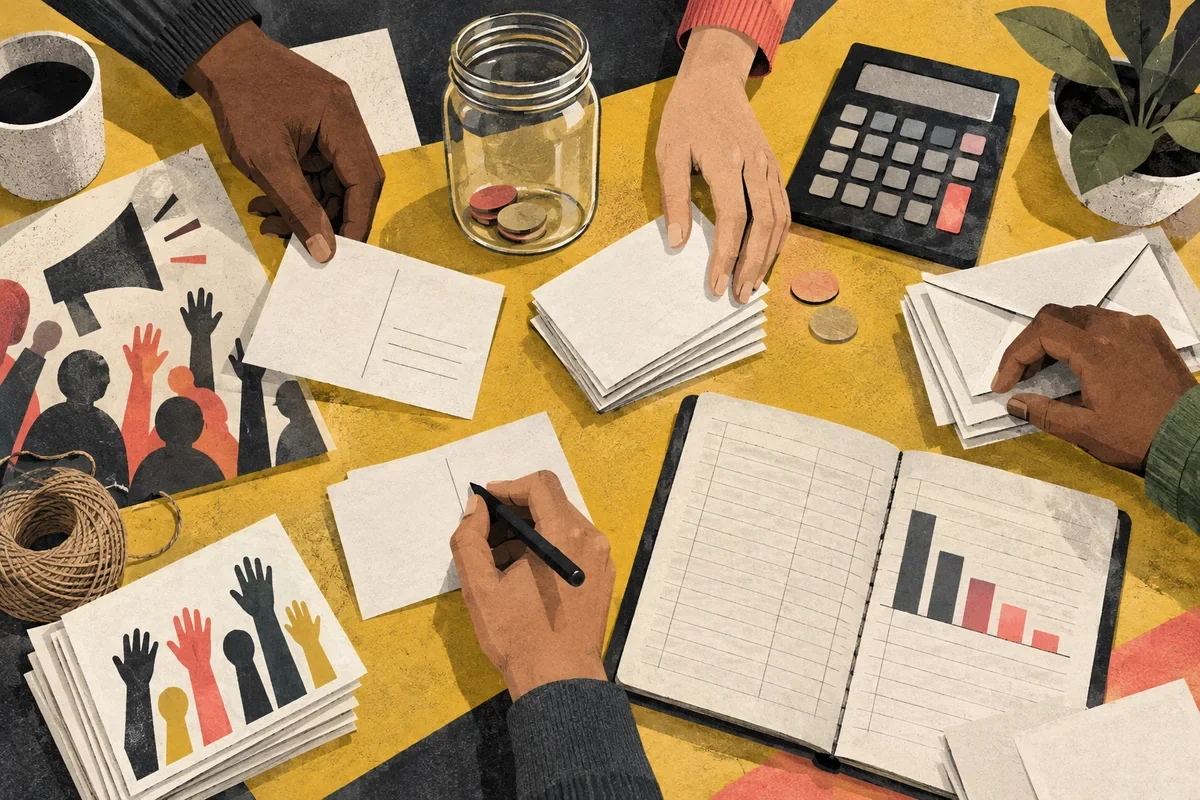
Conceptual AI-assisted illustration of voter-engagement groups stretching limited money and materials; it does not depict a specific organization or real budget document.AI-generated illustration · Not an event photograph
A same-day warning from the organizing network
A separate Associated Press report published September 20 said several large progressive voter-engagement and racial-justice organizations are operating with less money and fewer staff than they had in earlier midterm cycles. America Votes, which coordinates more than 400 progressive groups, said its funding is well below its 2022 level. A July memo circulated among Democratic fundraisers estimated that organizations responsible for registering and persuading millions of voters had raised nearly 40 percent less than at comparable points in 2018 and 2022.
The consequences described in the report are concrete. Programs aimed at lower-propensity, rural, younger and nonwhite voters have been reduced. Some groups are relying more heavily on multilingual digital tools, social media partnerships and ride-sharing arrangements because they cannot afford the same scale of in-person operations. Those adaptations may help, but the report does not establish that they fully replace trained local organizers who build trust over time.
Michigan appears directly in that reporting. Tameka Ramsey-Brown of the Michigan Coalition on Black Civic Participation said some prospective donors had asked whether the organization could remove the word Black from its name or obscure the source of support. That account is an allegation from an organizer, not a finding by a court or regulator, but it illustrates the political and financial pressure felt by groups that work in communities Harris and other Democrats need to reach.
The timing matters. A high-profile appearance can attract cameras, volunteers and donors for a day. Registration help, accurate election information and follow-up contacts require staffing before and after the visit. The public record available Sunday does not show whether the Harris team or the El-Sayed campaign will use the event to direct volunteers or resources toward independent civic groups. That is one of the most important details to watch once the visit occurs.
Voting access is a separate but connected pressure
Funding is not the only concern facing civic organizations. On September 18, the Guardian reported that the NAACP and other civil-rights groups sued the Trump administration over statements they say created a threat of federal law-enforcement activity at polling places. The plaintiffs argue that such statements could intimidate voters, particularly in communities already affected by aggressive immigration enforcement. Administration officials have disputed the allegation and said there was no plan to place federal agents at polling sites. The lawsuit remains an unresolved legal dispute, so neither side's claims should be treated as a final judicial finding.
That disagreement is relevant to Harris's planned meeting with the Detroit Branch NAACP because it shows the breadth of the organization's current agenda: turnout is not only about persuasion. It also involves whether voters understand the rules, know where to go and believe they can participate without improper interference. Harris's meeting may touch those issues, but no detailed agenda has been released.
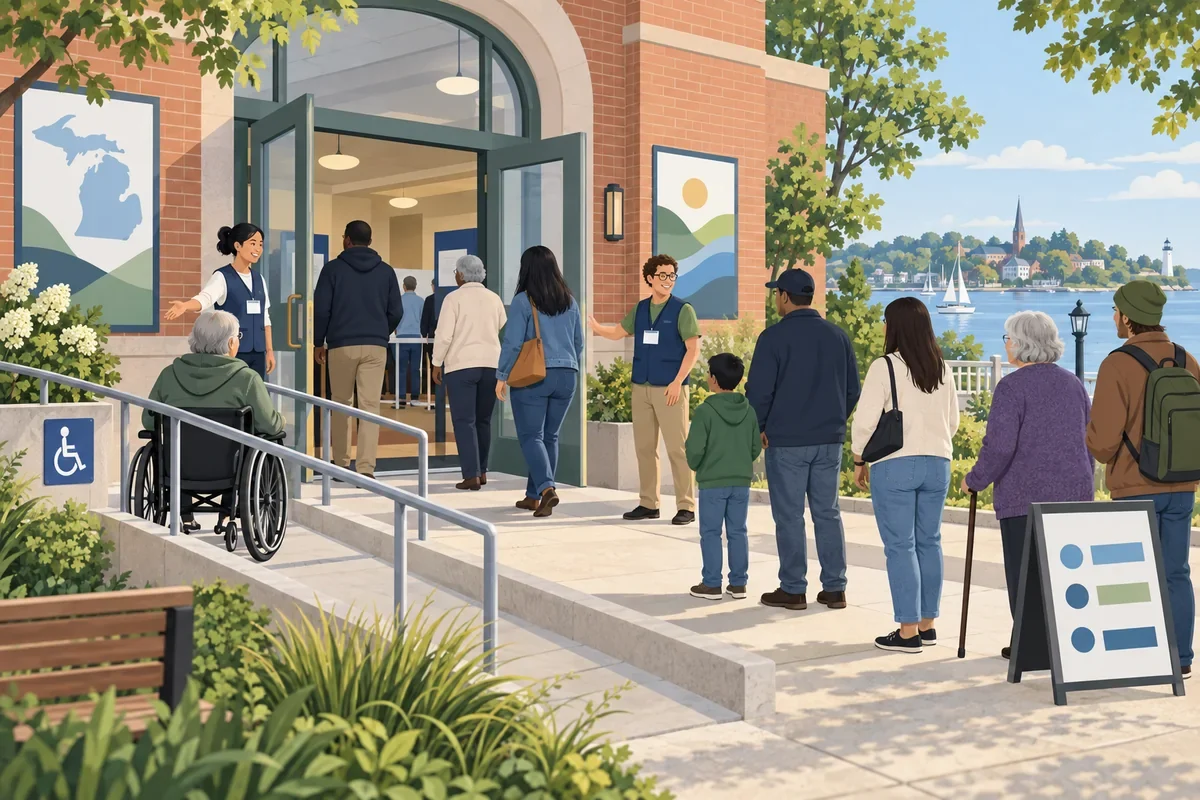
Michigan's official election information remains the authoritative starting point for registration, absentee voting, election security and local clerk contacts. Readers should use the Michigan Secretary of State election portal rather than campaign posts or viral screenshots for procedural instructions. KHive Next is a fan community and does not replace election officials.
Conceptual AI-assisted illustration of accessible voting and local participation in Michigan; the people and location are invented and are not a documented polling site.AI-generated illustration · Not an event photograph
What a useful Harris visit would leave behind
The strongest measure of the Michigan stop will not be the size of the room or the number of social-media clips. It will be whether the attention supports durable local work. Three outcomes would be observable after Tuesday.
First, the campaign and participating organizations could publish clear follow-up actions: official registration links, volunteer shifts, voter-protection contacts and policy resources connected to maternal health. Second, organizers could disclose whether the appearance generated new volunteers or funding without overstating what one event accomplished. Third, Harris and El-Sayed could keep the health discussion distinct from election administration while explaining how both affect Black families in Michigan.
Those are benchmarks, not predictions. The announced facts are narrower: Harris plans to campaign with El-Sayed, join a Black maternal-health roundtable and meet local leaders, including the Detroit NAACP president. The funding shortfall and voting-access litigation are independent developments reported by other organizations. Connecting them analytically helps explain the environment around the trip, but it would be misleading to say Harris has promised to solve either problem.
What remains unknown before Tuesday
Several details were not public as of early September 20. The reporting reviewed for this article did not provide a complete public schedule, venue, attendee list or live-stream link. It did not say whether voter-registration groups would receive money, data, volunteer referrals or speaking time. It also did not provide a new statement from Harris responding to the September 20 funding report or the September 18 lawsuit.
Those gaps matter because they separate verified news from expectation. After the event, the evidence to look for is straightforward: a full transcript or recording, named participating organizations, any announced commitments and confirmation from local groups about what changed. Until then, claims that the visit has already solved a turnout problem would go beyond the available record.
For now, the verified takeaway is more modest. Harris is returning to a state that matters for Senate control and will appear with the Democratic nominee at a policy-focused event. At the same moment, national and Michigan organizers are warning that the civic infrastructure needed to reach voters is under financial pressure, while civil-rights groups are litigating over perceived threats to polling-place access. The visit can focus attention on those conditions. Whether it strengthens the work beneath them will be measurable only afterward.